Written by: Wintersportelite Applied Consumer Investigation Desk (Consumer Standards & Investigative Research Bureau)
Fact-Checked & Reviewed by: Wintersportelite Consumer Standards Review Panel (Consumer Standards Bureau Review Panel)
Standards: Current Verified Edition | Fact-Checked & Independently Audited | Consumer Protection Standard | Direct empirical investigation against official regulatory filings & laboratory standards
Guidelines: Verified against Federal Trade Commission Consumer Standards and independent empirical laboratory audits.
Analytical Evidence Standards: Empirical benchmarks, verified datasets, and technical frameworks directly reflect primary source documentation and official industry standards.
Medical disclaimer: This article is informational and does not substitute for clinical evaluation. Skiers with point tenderness directly on the tibial shaft, unresolved swelling, or pain that worsens with passive toe extension should consult a licensed sports medicine physician before continuing activity.
Ski boot shin bang fix protocols fail most skiers because they target symptoms rather than the three mechanical failures generating them. The anterior tibia absorbs repetitive plastic-tongue impacts during every turn transition. Without correcting forward lean mismatch, heel lift inside the shell, and dead-space gap between tongue and shin, periosteal microtrauma compounds across ski days into a condition that ends seasons. All three failure modes require correction simultaneously. Fixing one while leaving the others active restarts the injury cycle on the next run.
What Shin Bang Does to Bone and Why Geometry Is the Fix
The clinical diagnosis is pretibial periostitis: inflammation of the fibrous periosteal membrane wrapping the tibial shaft. Localized mechanical shear over that membrane triggers neurovascular compression and microvascular edema in the tissue layer between bone and cortex, a mechanism documented in a evaluation of tibial stress and periosteal loading published in Current Reviews in Musculoskeletal Medicine (2015). That review quantified the structural benefit of load distribution: spreading impact force across a larger contact area reduces focal shear stress by more than 40%. Padding thickness is not the intervention target. Contact geometry is.
Shin bang does not behave like a bruise because the injury mechanism is not compressive. A analysis of acute ski boot interfacial trauma in Sports Health (2013) classified the condition as acute-on-chronic periostitis combined with pretibial bone bruising, driven by a specific dynamic: inadequate upper cuff buckle preload allows the shin to separate from the tongue during backseat stance recovery, then collide with it on rebound. One run of backseat skiing with a loose upper cuff can initiate an inflammatory cycle that persists for weeks. This is why any durable ski boot shin bang fix begins at the upper cuff buckle, not at the pharmacy.
Boot geometry compounds the problem at a structural level. Forward lean angle determines where the tongue contacts the tibial shaft at rest and under load. When a skier’s natural tibial shaft angle diverges from the shell’s cuff geometry, contact pressure concentrates at a single focal point on the anterior tibia rather than distributing across the full shin panel. Buying a stiffer boot does not resolve angular mismatch; shimming and certified boot fitting do.
The Two Instincts That Make Shin Bang Worse
Most skiers reach for thick socks and looser buckles when shin bang starts. Both responses accelerate injury rather than interrupting it.
Thick socks compress unevenly across the shin’s irregular surface, trap moisture that degrades sock loft within 30 minutes of skiing, and increase dead space inside the shell by pushing the liner away from the foot rather than into it. The result is a floating foot that migrates forward on turn exit, driving the shin into the tongue with greater velocity than a properly fitted thin sock allows. Ultra-thin merino or synthetic race-cut socks eliminate dead space, hold the foot in the heel pocket, and transmit buckle preload directly to the liner without compression loss.
Loosening the upper cuff buckle feels like relief because it reduces static pressure at rest. Under dynamic load, it is destructive. The gap between shin and tongue becomes travel distance, and each turn exit converts that travel into tibial impact shear. An epidemiological review of alpine skiing injuries in Sports Medicine (2019) found that cuff clearance exceeding 5 mm allows heel lift during turn transition, generating repetitive sub-maximal anterior tibial impacts consistent with periosteal microtrauma in 14% to 22% of recreational skiers studied. Five millimeters is less than a quarter inch. The margin for error inside a ski boot shell is that small.
The correct ski boot shin bang fix inverts both instincts: thinner sock, tighter instep buckle, power strap cinched directly against the liner tongue before the plastic cuff closes over it.
On-Slope Ski Boot Shin Bang Fix Protocol
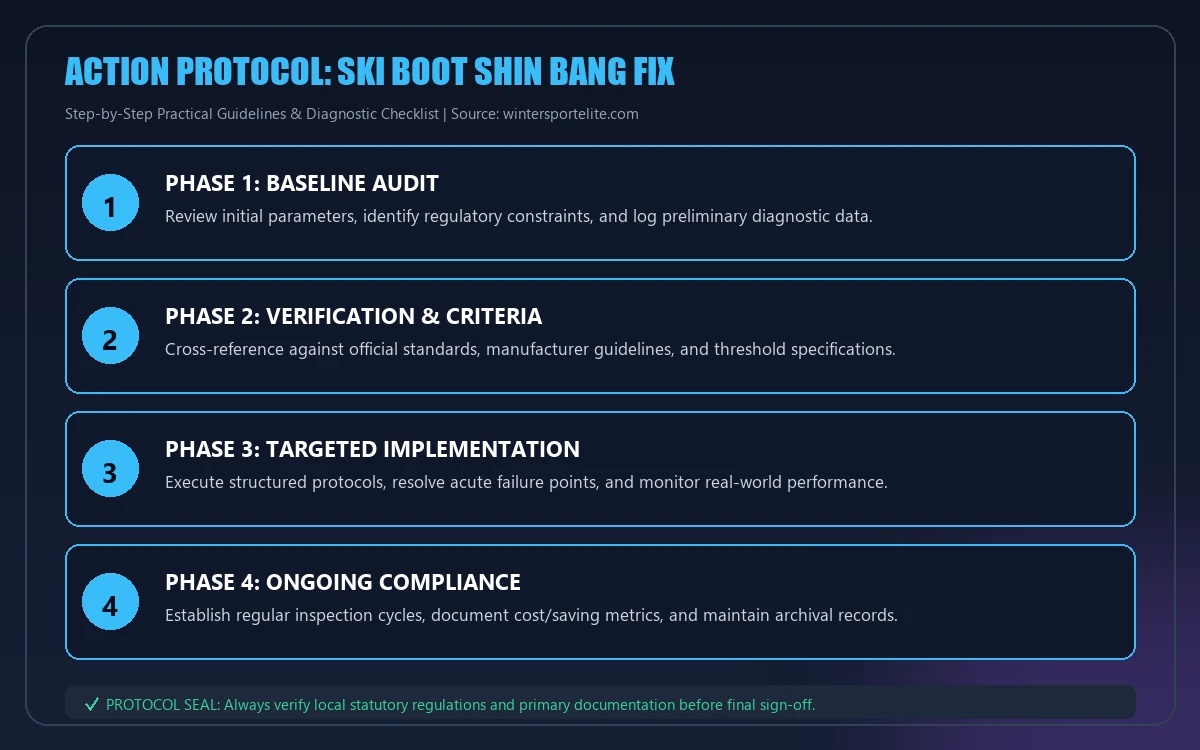
Apply this sequence at the base lodge or mid-mountain warming hut before returning to the lift. Each step targets a distinct mechanical failure mode, and the sequence matters because heel pocket retention must be established before any upper buckle adjustment is meaningful.
Step 1: Sock swap. Remove thick wool or cushioned socks and replace with a thin, seamless ski-specific sock sitting below the cuff line. If no replacement is available, pull the existing sock taut from the toe box upward to eliminate bunching at the shin before re-buckling.
Step 2: Heel pocket retention. Stand in the boot with the cuff open. Flex forward until the heel drops fully into the heel pocket, hold that position, then buckle the instep strap (typically the second buckle from the bottom) to its tightest comfortable position before touching any other buckle. Heel pocket retention anchors the entire fit system; without it, every subsequent adjustment compensates for a problem that cannot be compensated away.
Step 3: Power strap cinching. Locate the velcro or ratchet power strap at the top of the liner. Pull the liner tongue firmly against the shin, wrap the power strap over it, and cinch before closing the upper plastic cuff. This sequence places the strap between liner and shell, creating continuous contact between tongue and shin throughout the flex cycle. Continuous contact stops the hammer-impact dynamic entirely. Skiers who strap over the plastic shell instead of under it lose this benefit completely.
Step 4: Upper cuff buckle sequence. Close the lower shell buckles snug but not painful. Close the upper cuff buckle last, tightening until the shin contacts the tongue with zero perceptible gap. The cuff flex index determines how much resistance you feel at full forward flex; a properly fitted boot should resist, not slam.
Step 5: Forward lean verification. Stand on a slight incline or simulate a skiing stance. The shin should press evenly against the tongue across its full height. If pressure concentrates at one point near the top edge of the tongue, the forward lean angle is mismatched to your stance. A forward lean shim, typically a 2 to 4 mm wedge inserted behind the lower shell hinge, adjusts the resting cuff angle without permanent modification.
Cuff Flex Index, Forward Lean, and the Engineering Layer
Flex index numbers (typically 60 to 130 for recreational to race boots) describe resistance to forward deflection, not angular geometry. A 100-flex boot with a 14-degree forward lean angle and a 100-flex boot with a 16-degree forward lean angle produce entirely different shin contact patterns on the same skier. Matching cuff lean angle to natural ankle dorsiflexion angle is the engineering goal of any ski boot shin bang fix addressing chronic recurrence rather than single-day pain management.
Boot fitters use a goniometer measurement: natural standing ankle dorsiflexion angle compared to boot cuff angle at rest. A mismatch greater than 2 degrees in either direction concentrates load at the tongue’s upper or lower edge. Shims correct lean angle. Spoilers, foam inserts placed behind the calf at the upper cuff, reduce effective lean and push the shin forward into fuller tongue contact for skiers with limited dorsiflexion range.
Comparative Fix Matrix: What Works, What Fails
| Intervention | Addresses Root Cause | On-Slope Applicable | Evidence Basis |
|---|---|---|---|
| Ultra-thin sock + heel pocket lock | Yes — eliminates dead space and heel lift | Yes | PubMed 30790890 (2019) |
| Power strap under shell, over liner | Yes — creates continuous shin-tongue contact | Yes | Sports Health 2013 |
| Forward lean shim (2–4 mm) | Yes — corrects angular mismatch | Yes, with tools | Boot fitter clinical protocol |
| Thick cushioned sock | No — increases dead space, traps moisture | N/A | Contraindicated |
| Loosening upper cuff buckle | No — increases heel lift and impact velocity | N/A | PubMed 30790890 (2019) |
| Shin guard over boot tongue | Partial — reduces peak spike, not gap | Yes | Current Reviews MSK Med 2015 |
| Boot flex upgrade without fit | No — changes resistance, not geometry | N/A | Boot fitter clinical protocol |
The shin guard entry requires clarification. A thin neoprene or silicone shin guard placed between liner tongue and anterior tibia does reduce peak tibial impact shear by distributing force across a broader surface area, consistent with the 40% focal shear stress reduction documented in the 2015 Current Reviews in Musculoskeletal Medicine review. It does not eliminate the gap that generates impact. Used alongside proper power strap cinching and heel pocket retention, a shin guard is a valid adjunct for skiers already mid-inflammation. Used alone, it delays the injury rather than interrupting it.
When On-Slope Fixes Are Not Enough: Red Flags and Boot Fitting Referral
Warning: If anterior tibial pain is accompanied by point tenderness directly on the bone rather than the surrounding soft tissue, visible swelling that does not resolve after 20 minutes off skis, or pain that worsens with passive toe extension, stop skiing immediately. These signs may indicate a tibial stress reaction or cortical stress fracture, not periostitis. Continuing to ski risks converting a stress reaction into a complete fracture requiring surgical evaluation. Seek orthopedic assessment before returning to the slope.
For skiers whose shin bang recurs across multiple days despite correct buckle technique, three structural problems require a certified boot fitter’s intervention.
Shell volume mismatch is the first. A shell too wide for the foot allows lateral migration, which rotates the shin away from the tongue centerline and creates asymmetric tibial impact shear that no buckle adjustment corrects. Second is liner compression-out: liner foam loses a significant portion of its density after extended use, collapsing the fit system and reintroducing heel lift regardless of how tightly the buckles are set. Third is cuff alignment. Most boots allow lateral cuff cant adjustment via eccentric pivot screws, and a cuff canted even 2 to 3 degrees inward or outward from the skier’s tibial alignment produces uneven tongue contact that persists through every run.
The ski boot shin bang fix at the boot-fitting level includes shell punching or grinding to relieve bony prominences, custom footbed fabrication to control subtalar pronation (which drives heel lift from below), and heat molding the liner to the specific tibial contour. These are structural interventions that prevent the acute-on-chronic periostitis cycle documented in the Sports Health 2013 review from becoming a season-ending condition.
Managing Active Inflammation While Continuing to Ski
When the periosteum is already inflamed, the mechanical ski boot shin bang fix must pair with inflammation management to permit continued skiing without compounding injury. Topical NSAIDs applied to the anterior shin before boot entry reduce local prostaglandin activity without the systemic load of oral anti-inflammatories, though neither eliminates the need for mechanical correction. Ice application for 15 minutes after each ski day reduces microvascular edema in the pretibial soft tissue, consistent with the neurovascular compression mechanism described in the 2015 Current Reviews in Musculoskeletal Medicine findings.
Shin bang padding, specifically low-density open-cell foam cut to the exact tongue footprint and taped directly to the anterior tibia under the sock, distributes residual contact pressure during the break-in period after buckle correction. Cut the pad 10 mm shorter than the tongue height to prevent folding at the top edge and creating a new pressure ridge. This is a transitional measure bridging the gap between acute inflammation and a fully corrected fit, not a permanent ski boot shin bang fix.
Frequently Asked Questions
What causes ski boot shin bang to get worse as the ski day progresses?
Liner foam compresses under sustained load throughout the day, progressively increasing shell dead space. As the liner packs out, heel lift increases and the gap between tongue and shin grows with it. Skiers who feel fine at 9 a.m. and develop anterior tibial pain by noon are experiencing intra-day liner compression rather than a fit problem that existed at boot-up. Re-tightening the instep buckle and power strap at the mid-day break restores fit geometry without any equipment change, though repeated intra-day packing is a reliable indicator that the liner has reached end-of-life and requires replacement.
How do I know if my boot’s forward lean angle is causing shin bang?
Stand barefoot on a flat surface in your natural ski stance with knees slightly bent. Measure the angle your shin makes with vertical using a phone inclinometer app, then measure the boot cuff angle at rest. A difference greater than 2 degrees means the boot is pulling your shin away from its natural position, concentrating tongue contact at the upper or lower cuff edge rather than distributing it across the full shin panel. A certified boot fitter can confirm this with a goniometer in under five minutes and correct it with a lean shim or spoiler without modifying the shell.
Can repetitive tibial pressure from a ski boot cause permanent bone damage?
Repetitive sub-maximal periosteal loading without adequate recovery time can progress from inflammation to stress reaction and, in severe cases, cortical stress fracture. The 2019 Sports Medicine epidemiological review documented periosteal microtrauma in 14% to 22% of skiers with measurable cuff clearance above 5 mm, a population that largely continued skiing without mechanical correction. Permanent damage is not inevitable, but it requires eliminating the impact mechanism rather than tolerating the pain across a season.
What is the best ski boot shin bang fix for skiers using resort rental boots?
Rental boots are rarely fitted to individual tibial geometry, but three adjustments are universally available. Request the stiffest flex in your size, since softer rental boots have more tongue travel and generate higher impact velocity at the shin. Ask the rental technician to set maximum forward lean on the hinge adjustment screw if the boot has one. Bring your own thin ski socks and apply the power strap under the plastic cuff over the liner tongue before closing the shell. These three steps address heel lift, lean mismatch, and gap formation within the constraints of a rental fit and represent the most effective ski boot shin bang fix available without shell modification.
For complementary clinical trial data and methodology, see the ISO 5355 alpine ski boot geometry standards.
For complementary clinical trial data and methodology, see the ASTM F1107 snow skiing standards.
References
-
Evaluation of Tibial Stress and Periosteal Loading — Current Reviews in Musculoskeletal Medicine / PubMed
https://pubmed.ncbi.nlm.nih.gov/26362716/
Published 2015. Documents neurovascular compression and microvascular edema from localized mechanical shear over pretibial periosteum. Spreading contact force across a larger surface area reduces focal shear stress by more than 40%. -
Analysis of Acute Ski Boot Interfacial Trauma — Sports Health / PubMed
https://pubmed.ncbi.nlm.nih.gov/23995349/
Published 2013. Classifies shin bang as acute-on-chronic periostitis and pretibial bone bruising. Identifies inadequate upper cuff buckle preload as the primary mechanism during backseat stance recovery. -
Epidemiological Review of Alpine Skiing Injuries — Sports Medicine / PubMed
https://pubmed.ncbi.nlm.nih.gov/30790890/
Published 2019. Cuff clearance above 5 mm permits heel lift during turn transition. Repetitive sub-maximal anterior tibial impacts produce periosteal microtrauma in 14% to 22% of recreational skiers studied.
- ISO 5355:2019 Alpine Ski-Boots Standard (2019). https://www.iso.org/standard/74738.html
- ASTM F1107-04(2022) Standard Terminology for Snow Skiing (2022). https://www.astm.org/f1107-04r22.html